

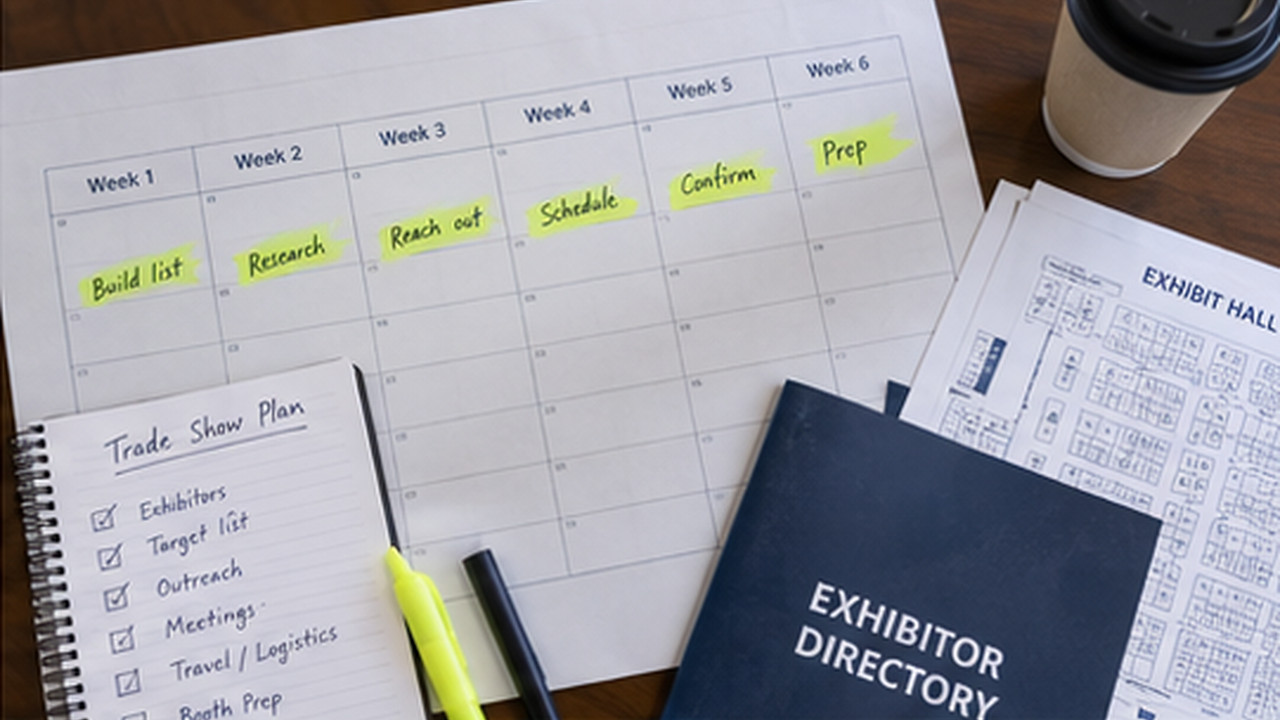
Most exhibitors plan the booth for months and plan their meetings for about a week. The result is predictable: the team spends the show talking to whoever walks by, and the distributor or supplier they actually needed was three aisles away the whole time.
The companies worth meeting are often exhibitors themselves. They have booths, staff, and a schedule of their own, which means they will not wander over to you. If you want to meet them, the meeting has to be set before the show starts. Six weeks is about the minimum lead time to do that well. Here is how to use it.
Six weeks out: decide who you actually want to meet
Start with the outcome, not the list. Write down the two or three kinds of company that would change your year if you met the right one. Be specific:
- "Regional distributors in the Southeast who don't carry a competing line."
- "A contract manufacturer who could produce our private-label version."
- "Brands that sell to the same buyers we do, for a possible bundle."
Then write down who is off limits: competitors, current customers, and anyone you are already talking to. This takes 30 minutes and it is the most important half hour of the whole plan. Every later step depends on it.
Five weeks out: work the exhibitor list
Every show publishes a list of exhibitors. It is usually long, loosely categorized, and easy to ignore. It is also the single most useful document you have, because every company on it has already committed to being in the same building, the same week, as you.
Go through it with your targets in mind and build a shortlist. For each company you keep, write one or two sentences on why the meeting makes sense for both sides. If you cannot write that sentence, drop the company. "They're also at the show" is not a reason, and it will not get a reply.
Aim for quality over volume. Ten to twenty companies with a real reason behind each will produce more meetings than a hundred names with none.
Four weeks out: find the right person at each company
A meeting with the wrong person is a pleasant conversation that goes nowhere. For a distribution conversation, you want whoever owns dealer or channel relationships. For a supplier, whoever runs sourcing or product. For a bundle or partnership, a sales or marketing lead with authority to say yes.
Company websites, LinkedIn, and the show's own exhibitor profiles usually get you there. Note the name and role next to each company on your shortlist.
Three weeks out: send short, specific introductions
Keep the first email to a few sentences:
- Who you are and that you are exhibiting at the same show, with your booth number.
- The specific reason a conversation makes sense for them.
- A concrete ask: 20 minutes at their booth or yours, on a specific day, or a short video call before the show.
One company per email. No attachments, no deck, no mail merge. The goal is not to sell anything yet; it is to get a yes to a short conversation.
Two weeks out: follow up once, then confirm
Busy exhibitors miss emails. A single polite follow-up a few days later is reasonable. After that, move on to the next name; chasing does more harm to your reputation than it does good for your calendar.
When someone says yes, confirm the details in writing: the day, the time, and the booth number or video link. A vague "let's find each other at the show" rarely turns into a meeting on a crowded floor.
The week before: brief your team
For each confirmed meeting, put together a single page your team can read in two minutes: who the company is, who you are meeting, why the meeting matters, and the first question to ask. The team member walking over should know exactly why they are there. You can see an example brief here.
If you would rather not do this yourself
Every step above is work your team would be doing in the weeks when they are also shipping the booth, booking travel, and running the business. That is the work Exhibit Meetings does: we research your show's exhibitor list, write the reason for each match, introduce you personally with both sides copied, and put confirmed meetings on your calendar with a brief for each.
If your show is six or more weeks out, book a 15-minute call or send us the show details. We will tell you within one business day whether we see enough strong targets on the list to make it worth it.